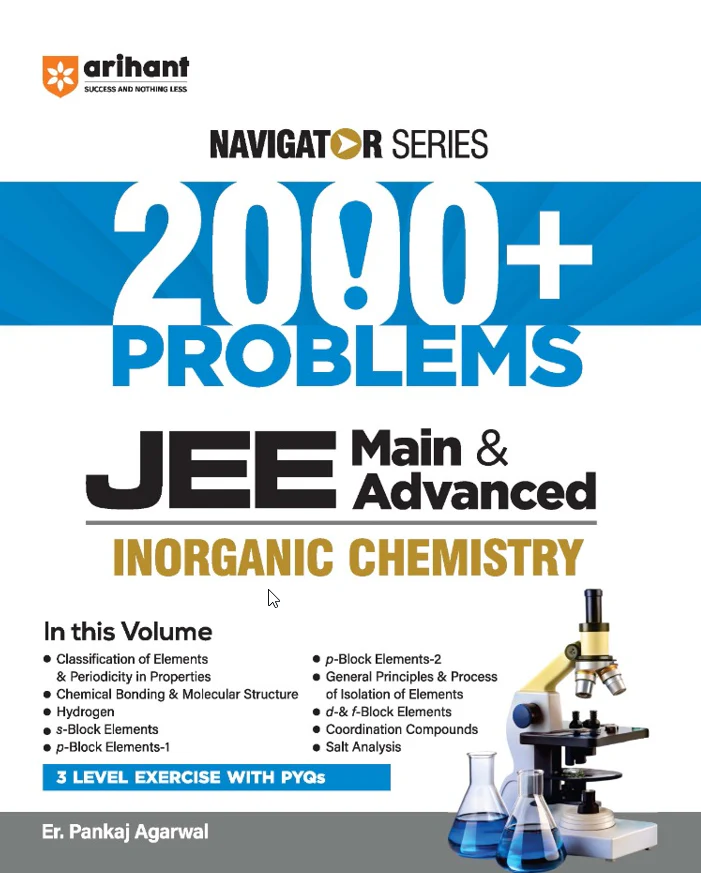
Navigator Series JEE Main & Advanced 2027 – Inorganic Chemistry | 2000+ Problems | Classification of Elements, Periodicity, s-Block, p-Block, d-Block, Coordination Compounds | Practice with PYQs
Overview:
Inorganic Chemistry is often the "X-factor" in JEE preparation—it is the section where you can score the maximum marks in the minimum time. This volume of the Navigator Series is meticulously designed to move beyond rote memorisation. It provides a logical framework to understand periodic trends, chemical bonding, and the complex behaviour of transition elements. The 2027 edition is strictly aligned with the streamlined NTA syllabus, focusing on conceptual clarity and the "logic of exceptions."
Genre: Engineering Entrance | Chemistry | Inorganic Chemistry Specialisation
Audience: Class 11 & 12 students and JEE 2027 aspirants who want to master "Block Chemistry" and Coordination Compounds through a systematic, problem-solving approach.
Key Features:
-
Logic-Based Theory: Instead of just listing facts, the book explains the why behind periodic trends and chemical anomalies using effective nuclear charge, shielding effects, and orbital symmetry.
-
Complete Block Chemistry Coverage:
-
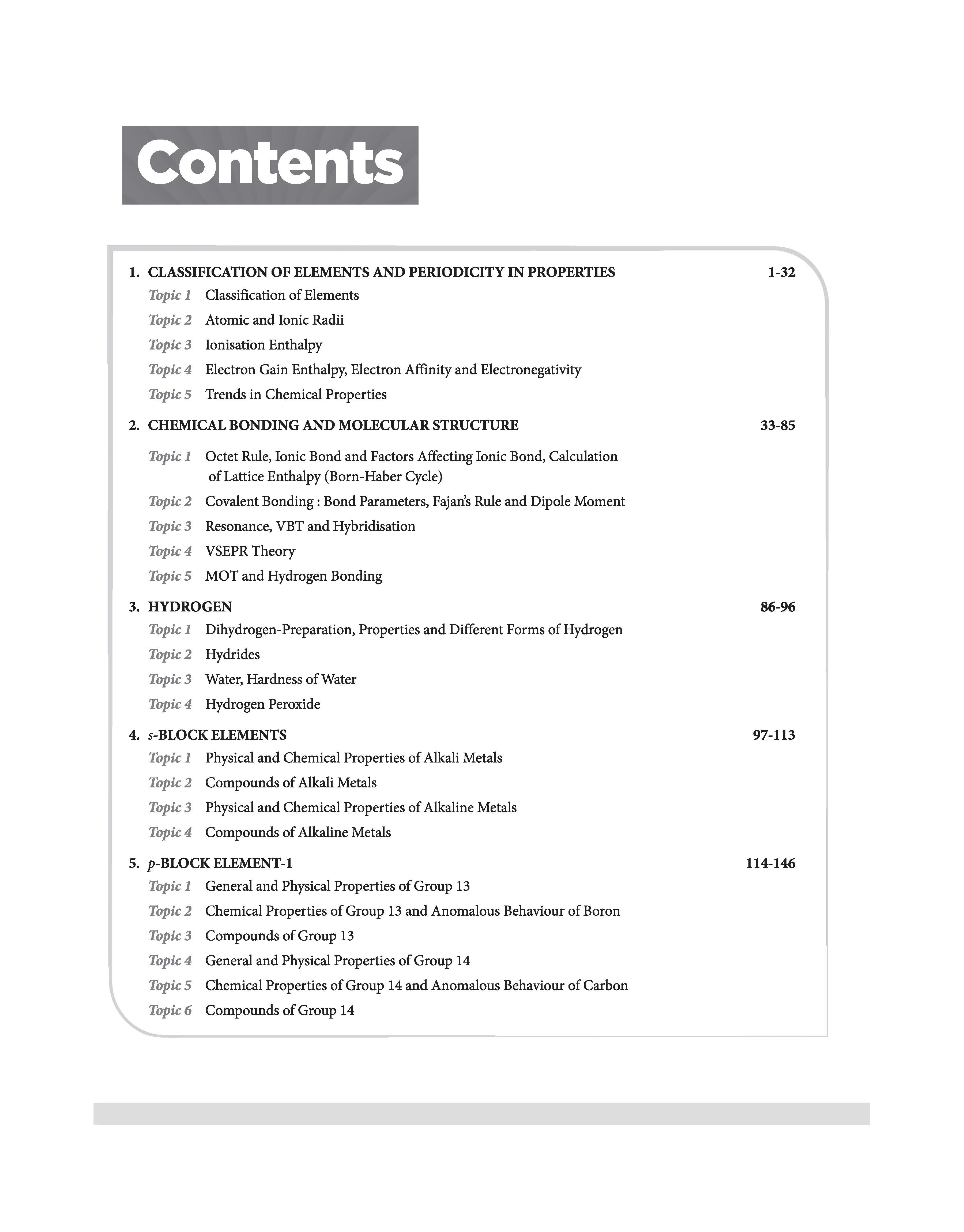
Classification of Elements & Periodicity: Mastering $Z_{eff}$, Ionisation Enthalpy, and Electronegativity.
-
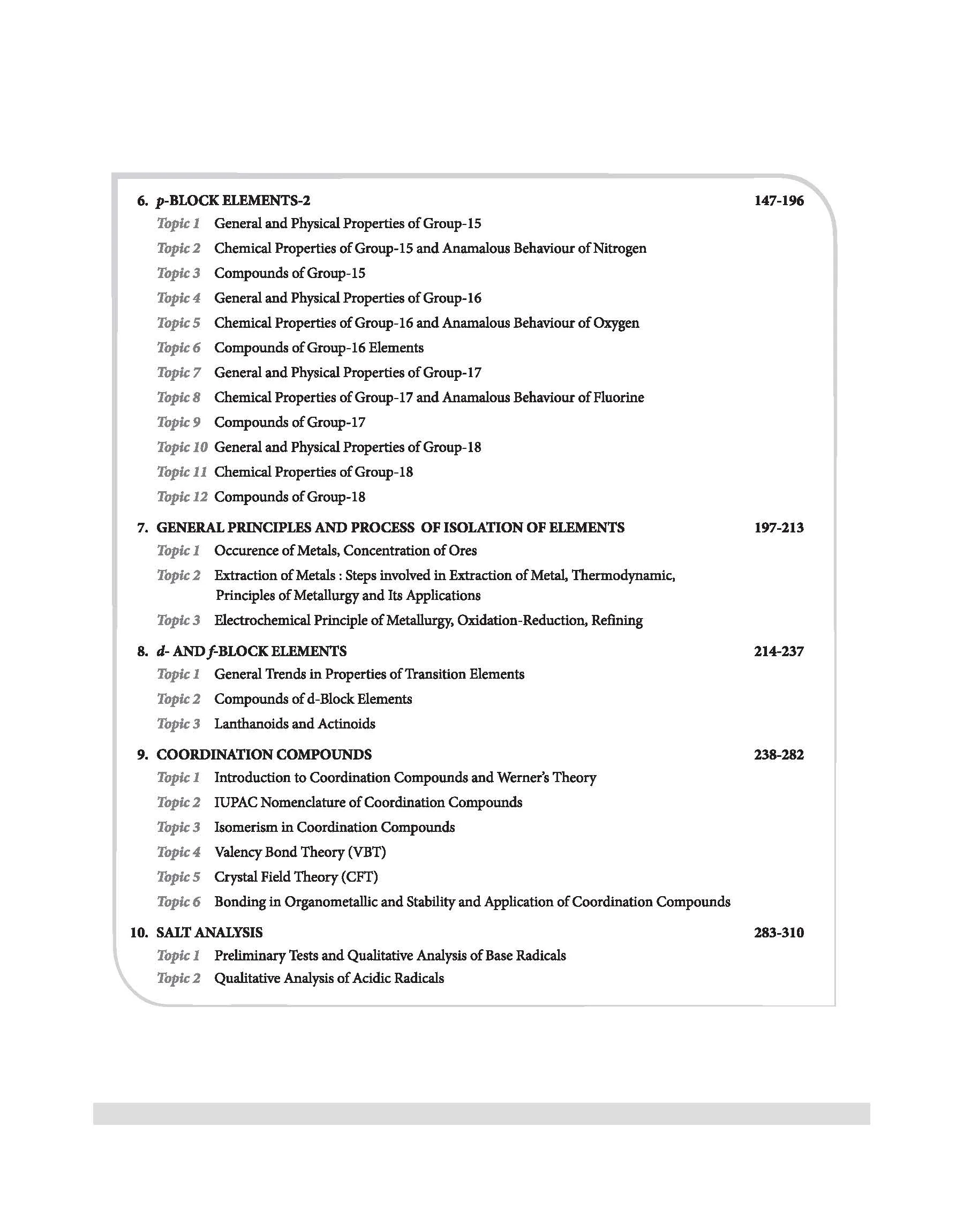
s-Block & p-Block Elements: Detailed study of group trends, anomalous behaviour of second-period elements, and important compounds.
-
d-Block & f-Block (Transition Elements): Focus on oxidation states, magnetic properties, and the Lanthanoid contraction.
-
Coordination Compounds: In-depth analysis of IUPAC nomenclature, Isomerism, Crystal Field Theory (CFT), and Valence Bond Theory (VBT).
-
-
2000+ High-Yield Problems: A massive repository including:
-
Fact-Based MCQs: For speed and accuracy in JEE Main.
-
Structure-Based Questions: Identifying geometry, hybridisation, and lone pairs.
-
Assertion-Reason & Statement-Type: To handle the increasing complexity of NTA-style papers.
-
-
The "Reaction Navigator": A specialised section that categorises major inorganic reactions (Redox, Hydrolysis, Thermal Decomposition) into easy-to-remember patterns.
-
Visual Structure Maps: High-quality 3D representations of chemical structures, including Silicates, Boranes, and Coordination complexes.
-
Integrated PYQs (2019–2025): Chapter-wise solved Previous Year Questions to help you distinguish between "important" and "incidental" information.
Why Choose This Book?
Inorganic Chemistry is 40% memory and 60% logic. This book is the right choice because it treats the Periodic Table as a Map. By focusing on Coordination Chemistry (one of the highest weightage topics), the book ensures you master the calculation of Crystal Field Stabilisation Energy (CFSE) and Isomerism with precision. The "Logic of Exceptions" boxes help you understand why certain elements deviate from general trends, making you immune to the "trap" questions often set by IIT-JEE examiners.
Product Information
Product Information
Shipping & Returns
Shipping & Returns
Navigator Series JEE Main & Advanced 2027 – Inorganic Chemistry | 2000+ Problems | Classification of Elements, Periodicity, s-Block, p-Block, d-Block, Coordination Compounds | Practice with PYQs
Navigator Series JEE Main & Advanced 2027 – Inorganic Chemistry | 2000+ Problems | Classification of Elements, Periodicity, s-Block, p-Block, d-Block, Coordination Compounds | Practice with PYQs
Overview:
Inorganic Chemistry is often the "X-factor" in JEE preparation—it is the section where you can score the maximum marks in the minimum time. This volume of the Navigator Series is meticulously designed to move beyond rote memorisation. It provides a logical framework to understand periodic trends, chemical bonding, and the complex behaviour of transition elements. The 2027 edition is strictly aligned with the streamlined NTA syllabus, focusing on conceptual clarity and the "logic of exceptions."
Genre: Engineering Entrance | Chemistry | Inorganic Chemistry Specialisation
Audience: Class 11 & 12 students and JEE 2027 aspirants who want to master "Block Chemistry" and Coordination Compounds through a systematic, problem-solving approach.
Key Features:
-
Logic-Based Theory: Instead of just listing facts, the book explains the why behind periodic trends and chemical anomalies using effective nuclear charge, shielding effects, and orbital symmetry.
-
Complete Block Chemistry Coverage:
-
Classification of Elements & Periodicity: Mastering $Z_{eff}$, Ionisation Enthalpy, and Electronegativity.
-
s-Block & p-Block Elements: Detailed study of group trends, anomalous behaviour of second-period elements, and important compounds.
-
d-Block & f-Block (Transition Elements): Focus on oxidation states, magnetic properties, and the Lanthanoid contraction.
-
Coordination Compounds: In-depth analysis of IUPAC nomenclature, Isomerism, Crystal Field Theory (CFT), and Valence Bond Theory (VBT).
-
-
2000+ High-Yield Problems: A massive repository including:
-
Fact-Based MCQs: For speed and accuracy in JEE Main.
-
Structure-Based Questions: Identifying geometry, hybridisation, and lone pairs.
-
Assertion-Reason & Statement-Type: To handle the increasing complexity of NTA-style papers.
-
-
The "Reaction Navigator": A specialised section that categorises major inorganic reactions (Redox, Hydrolysis, Thermal Decomposition) into easy-to-remember patterns.
-
Visual Structure Maps: High-quality 3D representations of chemical structures, including Silicates, Boranes, and Coordination complexes.
-
Integrated PYQs (2019–2025): Chapter-wise solved Previous Year Questions to help you distinguish between "important" and "incidental" information.
Why Choose This Book?
Inorganic Chemistry is 40% memory and 60% logic. This book is the right choice because it treats the Periodic Table as a Map. By focusing on Coordination Chemistry (one of the highest weightage topics), the book ensures you master the calculation of Crystal Field Stabilisation Energy (CFSE) and Isomerism with precision. The "Logic of Exceptions" boxes help you understand why certain elements deviate from general trends, making you immune to the "trap" questions often set by IIT-JEE examiners.
Product Information
Product Information
Shipping & Returns
Shipping & Returns
Description
Overview:
Inorganic Chemistry is often the "X-factor" in JEE preparation—it is the section where you can score the maximum marks in the minimum time. This volume of the Navigator Series is meticulously designed to move beyond rote memorisation. It provides a logical framework to understand periodic trends, chemical bonding, and the complex behaviour of transition elements. The 2027 edition is strictly aligned with the streamlined NTA syllabus, focusing on conceptual clarity and the "logic of exceptions."
Genre: Engineering Entrance | Chemistry | Inorganic Chemistry Specialisation
Audience: Class 11 & 12 students and JEE 2027 aspirants who want to master "Block Chemistry" and Coordination Compounds through a systematic, problem-solving approach.
Key Features:
-
Logic-Based Theory: Instead of just listing facts, the book explains the why behind periodic trends and chemical anomalies using effective nuclear charge, shielding effects, and orbital symmetry.
-
Complete Block Chemistry Coverage:
-
Classification of Elements & Periodicity: Mastering $Z_{eff}$, Ionisation Enthalpy, and Electronegativity.
-
s-Block & p-Block Elements: Detailed study of group trends, anomalous behaviour of second-period elements, and important compounds.
-
d-Block & f-Block (Transition Elements): Focus on oxidation states, magnetic properties, and the Lanthanoid contraction.
-
Coordination Compounds: In-depth analysis of IUPAC nomenclature, Isomerism, Crystal Field Theory (CFT), and Valence Bond Theory (VBT).
-
-
2000+ High-Yield Problems: A massive repository including:
-
Fact-Based MCQs: For speed and accuracy in JEE Main.
-
Structure-Based Questions: Identifying geometry, hybridisation, and lone pairs.
-
Assertion-Reason & Statement-Type: To handle the increasing complexity of NTA-style papers.
-
-
The "Reaction Navigator": A specialised section that categorises major inorganic reactions (Redox, Hydrolysis, Thermal Decomposition) into easy-to-remember patterns.
-
Visual Structure Maps: High-quality 3D representations of chemical structures, including Silicates, Boranes, and Coordination complexes.
-
Integrated PYQs (2019–2025): Chapter-wise solved Previous Year Questions to help you distinguish between "important" and "incidental" information.
Why Choose This Book?
Inorganic Chemistry is 40% memory and 60% logic. This book is the right choice because it treats the Periodic Table as a Map. By focusing on Coordination Chemistry (one of the highest weightage topics), the book ensures you master the calculation of Crystal Field Stabilisation Energy (CFSE) and Isomerism with precision. The "Logic of Exceptions" boxes help you understand why certain elements deviate from general trends, making you immune to the "trap" questions often set by IIT-JEE examiners.