Navigator Series JEE Main & Advanced 2027 – Electrostatic & Current Electricity | 2000+ Problems | Electric Field, Potential, Dipole, Capacitance, Current, RC Circuit | 3-Level Exercises with PYQs
Overview: Electrostatics and Current Electricity form the core of the Class 12 Physics syllabus, consistently accounting for the highest weightage in the JEE Main and Advanced papers. This volume of the Navigator Series is engineered to simplify the abstract nature of electric fields and the complex dynamics of circuits. The 2027 edition provides a rigorous, application-based framework that moves students from fundamental "Coulombic" laws to the sophisticated analysis of RC circuits and dielectric materials.
Genre: Engineering Entrance | Physics | Electromagnetism Specialization
Audience: Class 12 students, Droppers, and JEE 2027 aspirants aiming to master the conceptual and numerical depth of Electrodynamics.
Key Features:
-
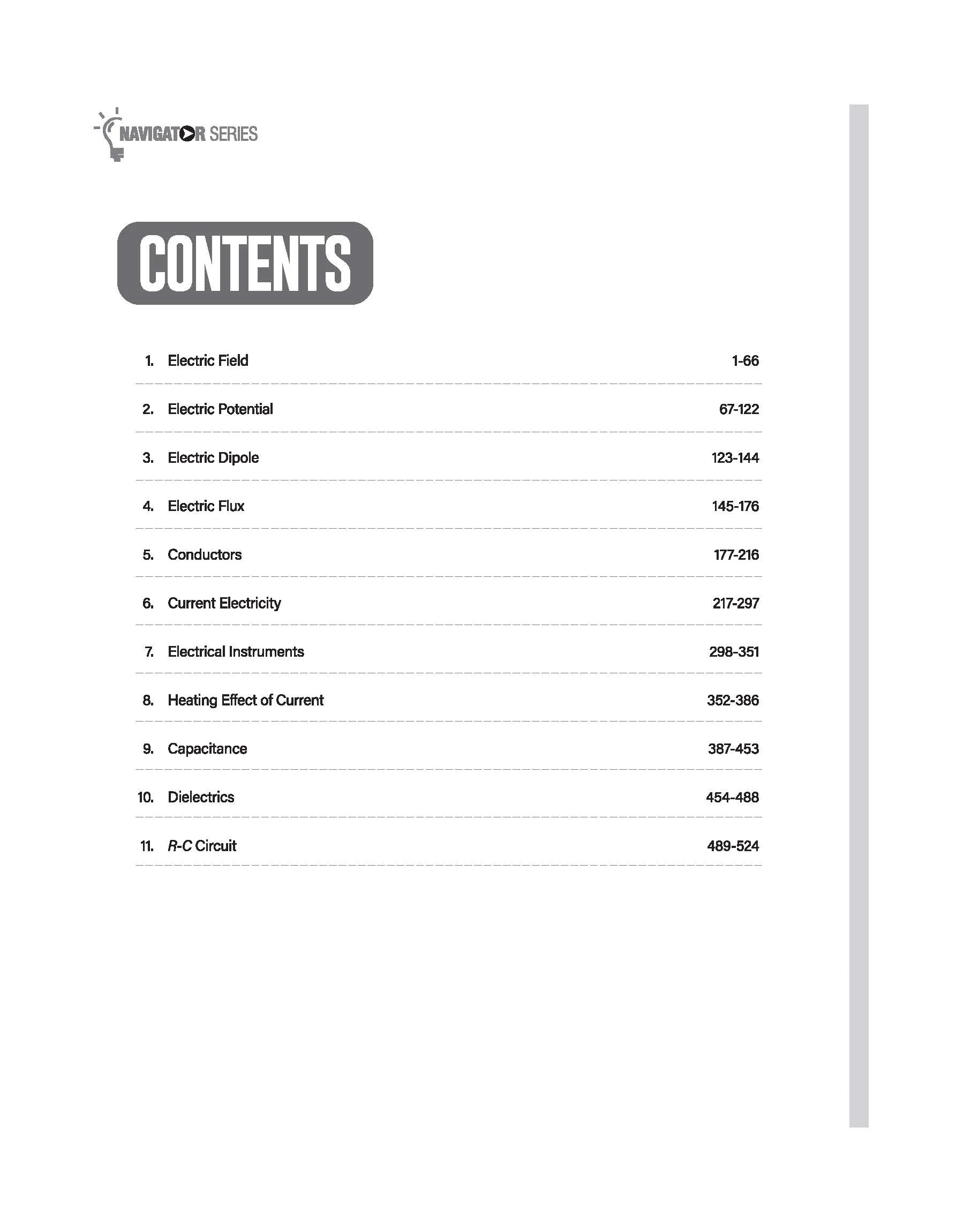
Complete Electrodynamics Roadmap: Comprehensive modules covering:
-
Electrostatic Force & Field: Mastering Gauss’s Law and its applications in various geometries.
-
Electric Potential & Dipole: Focus on conservative fields, equipotential surfaces, and dipole torque.
-
Capacitance: In-depth analysis of parallel plate capacitors, dielectrics, and energy storage.
-
Current Electricity: Covering Ohm’s Law, Kirchhoff’s Laws, and Bridge circuits.
-
RC Circuits: Detailed study of charging and discharging of capacitors with time-constant analysis.
-
-
2000+ Conceptual & Numerical Problems: A massive bank of questions ranging from theoretical "Assertion-Reason" to complex "Multi-loop" circuit problems.
-
3-Level Strategic Exercises:
-
Level 1 (Concept Primers): Direct application of formulas to build speed and accuracy for JEE Main.
-
Level 2 (JEE Probes): Questions involving variable charge distributions and non-standard circuit configurations.
-
Level 3 (Advanced Inquiry): Challenging problems that integrate Mechanics (e.g., motion of a charge in a field) with Electrostatics.
-
-
The "Circuit Navigator" Section: Specialised strategies for simplifying complex resistive and capacitive networks using Nodal Analysis and Symmetry.
-
Visual Concept Maps: High-quality diagrams illustrating field lines, potential gradients, and flux distribution.
-
Integrated PYQs (2019–2025): Chapter-wise segregation of previous years' questions to ensure alignment with current NTA and IIT testing trends.
Why Choose This Book?
Electrodynamics is often where students struggle with "integration" and "vector analysis." This book is the right choice because it utilizes a Visual-First approach. Instead of just providing formulas, it helps students visualise flux through a surface or the potential drop across a resistor. The RC Circuit analysis in this volume is particularly renowned for its clarity, providing a step-by-step mathematical guide to transient states that are frequently tested in JEE Advanced.
Product Information
Product Information
Shipping & Returns
Shipping & Returns
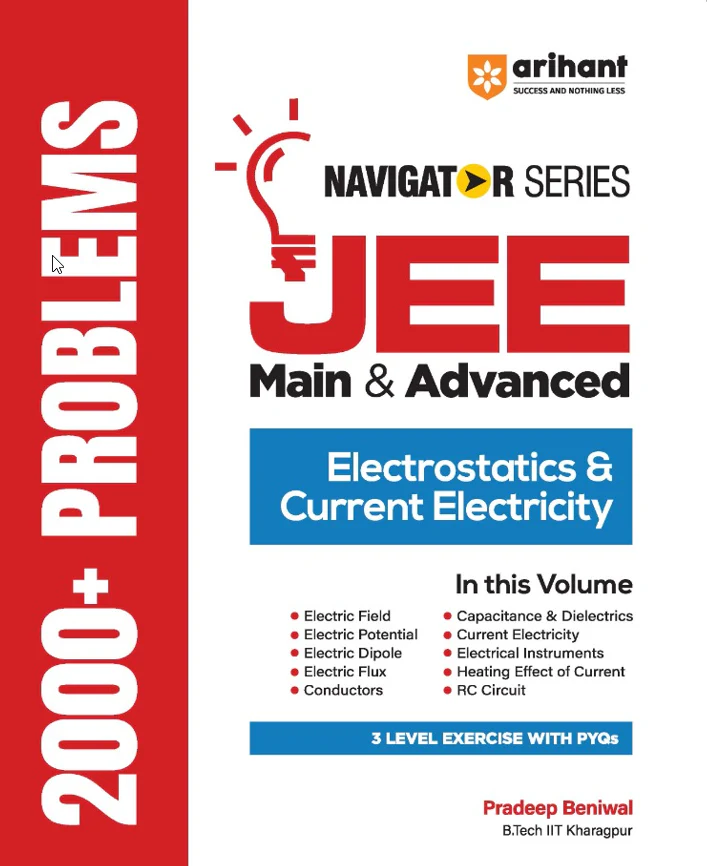

Navigator Series JEE Main & Advanced 2027 – Electrostatic & Current Electricity | 2000+ Problems | Electric Field, Potential, Dipole, Capacitance, Current, RC Circuit | 3-Level Exercises with PYQs
Navigator Series JEE Main & Advanced 2027 – Electrostatic & Current Electricity | 2000+ Problems | Electric Field, Potential, Dipole, Capacitance, Current, RC Circuit | 3-Level Exercises with PYQs
Overview: Electrostatics and Current Electricity form the core of the Class 12 Physics syllabus, consistently accounting for the highest weightage in the JEE Main and Advanced papers. This volume of the Navigator Series is engineered to simplify the abstract nature of electric fields and the complex dynamics of circuits. The 2027 edition provides a rigorous, application-based framework that moves students from fundamental "Coulombic" laws to the sophisticated analysis of RC circuits and dielectric materials.
Genre: Engineering Entrance | Physics | Electromagnetism Specialization
Audience: Class 12 students, Droppers, and JEE 2027 aspirants aiming to master the conceptual and numerical depth of Electrodynamics.
Key Features:
-
Complete Electrodynamics Roadmap: Comprehensive modules covering:
-
Electrostatic Force & Field: Mastering Gauss’s Law and its applications in various geometries.
-
Electric Potential & Dipole: Focus on conservative fields, equipotential surfaces, and dipole torque.
-
Capacitance: In-depth analysis of parallel plate capacitors, dielectrics, and energy storage.
-
Current Electricity: Covering Ohm’s Law, Kirchhoff’s Laws, and Bridge circuits.
-
RC Circuits: Detailed study of charging and discharging of capacitors with time-constant analysis.
-
-
2000+ Conceptual & Numerical Problems: A massive bank of questions ranging from theoretical "Assertion-Reason" to complex "Multi-loop" circuit problems.
-
3-Level Strategic Exercises:
-
Level 1 (Concept Primers): Direct application of formulas to build speed and accuracy for JEE Main.
-
Level 2 (JEE Probes): Questions involving variable charge distributions and non-standard circuit configurations.
-
Level 3 (Advanced Inquiry): Challenging problems that integrate Mechanics (e.g., motion of a charge in a field) with Electrostatics.
-
-
The "Circuit Navigator" Section: Specialised strategies for simplifying complex resistive and capacitive networks using Nodal Analysis and Symmetry.
-
Visual Concept Maps: High-quality diagrams illustrating field lines, potential gradients, and flux distribution.
-
Integrated PYQs (2019–2025): Chapter-wise segregation of previous years' questions to ensure alignment with current NTA and IIT testing trends.
Why Choose This Book?
Electrodynamics is often where students struggle with "integration" and "vector analysis." This book is the right choice because it utilizes a Visual-First approach. Instead of just providing formulas, it helps students visualise flux through a surface or the potential drop across a resistor. The RC Circuit analysis in this volume is particularly renowned for its clarity, providing a step-by-step mathematical guide to transient states that are frequently tested in JEE Advanced.
Original: $4.56
-70%$4.56
$1.37Product Information
Product Information
Shipping & Returns
Shipping & Returns
Description
Overview: Electrostatics and Current Electricity form the core of the Class 12 Physics syllabus, consistently accounting for the highest weightage in the JEE Main and Advanced papers. This volume of the Navigator Series is engineered to simplify the abstract nature of electric fields and the complex dynamics of circuits. The 2027 edition provides a rigorous, application-based framework that moves students from fundamental "Coulombic" laws to the sophisticated analysis of RC circuits and dielectric materials.
Genre: Engineering Entrance | Physics | Electromagnetism Specialization
Audience: Class 12 students, Droppers, and JEE 2027 aspirants aiming to master the conceptual and numerical depth of Electrodynamics.
Key Features:
-
Complete Electrodynamics Roadmap: Comprehensive modules covering:
-
Electrostatic Force & Field: Mastering Gauss’s Law and its applications in various geometries.
-
Electric Potential & Dipole: Focus on conservative fields, equipotential surfaces, and dipole torque.
-
Capacitance: In-depth analysis of parallel plate capacitors, dielectrics, and energy storage.
-
Current Electricity: Covering Ohm’s Law, Kirchhoff’s Laws, and Bridge circuits.
-
RC Circuits: Detailed study of charging and discharging of capacitors with time-constant analysis.
-
-
2000+ Conceptual & Numerical Problems: A massive bank of questions ranging from theoretical "Assertion-Reason" to complex "Multi-loop" circuit problems.
-
3-Level Strategic Exercises:
-
Level 1 (Concept Primers): Direct application of formulas to build speed and accuracy for JEE Main.
-
Level 2 (JEE Probes): Questions involving variable charge distributions and non-standard circuit configurations.
-
Level 3 (Advanced Inquiry): Challenging problems that integrate Mechanics (e.g., motion of a charge in a field) with Electrostatics.
-
-
The "Circuit Navigator" Section: Specialised strategies for simplifying complex resistive and capacitive networks using Nodal Analysis and Symmetry.
-
Visual Concept Maps: High-quality diagrams illustrating field lines, potential gradients, and flux distribution.
-
Integrated PYQs (2019–2025): Chapter-wise segregation of previous years' questions to ensure alignment with current NTA and IIT testing trends.
Why Choose This Book?
Electrodynamics is often where students struggle with "integration" and "vector analysis." This book is the right choice because it utilizes a Visual-First approach. Instead of just providing formulas, it helps students visualise flux through a surface or the potential drop across a resistor. The RC Circuit analysis in this volume is particularly renowned for its clarity, providing a step-by-step mathematical guide to transient states that are frequently tested in JEE Advanced.